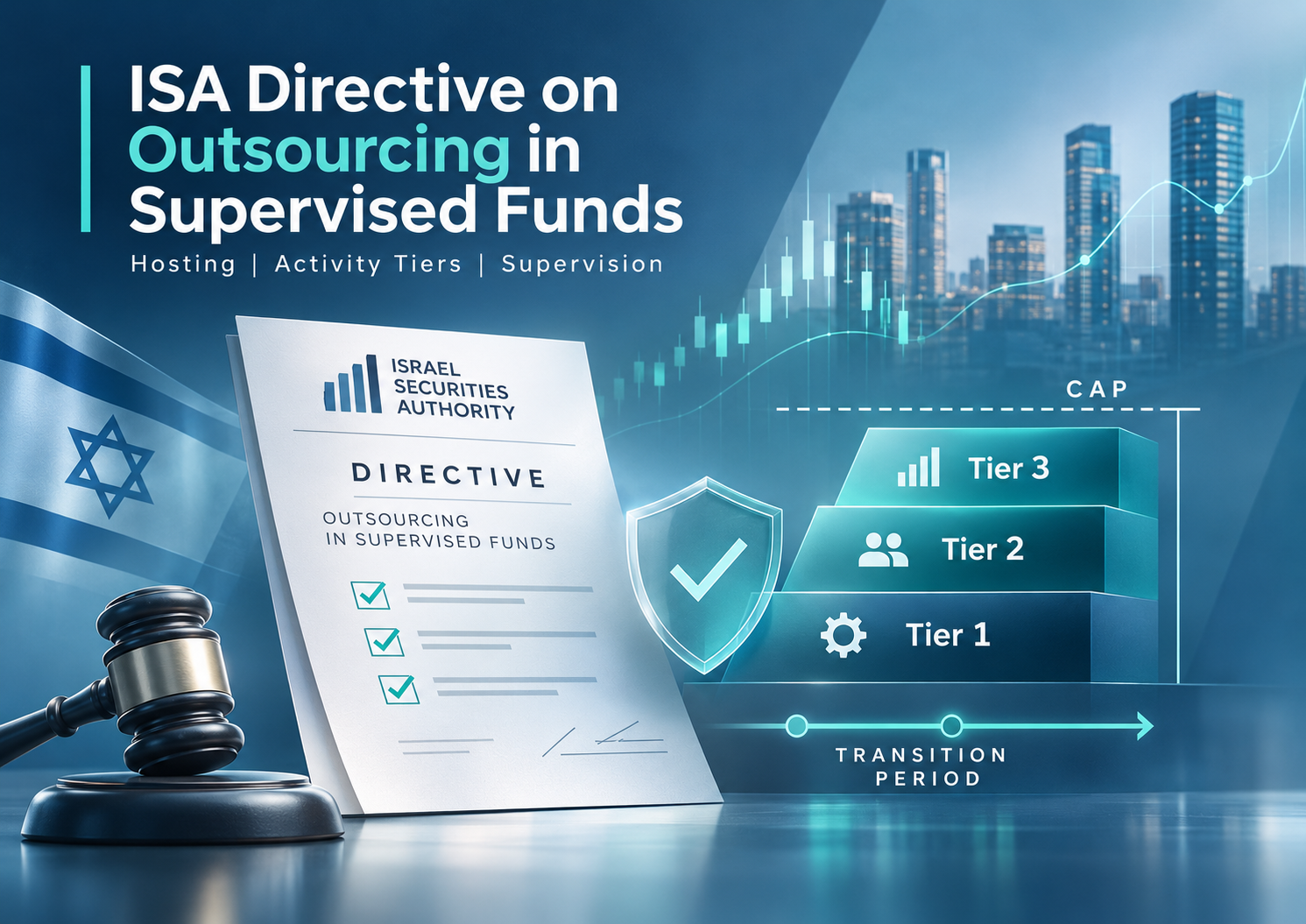
Recently, the Israel Securities Authority (ISA) published a directive to fund managers and trustees on rules of outsourcing investment management in supervised funds (קרנות נאמנות; the “funds”).
The directive covers two models: management of a fund’s investments by a portfolio management company (“hosting”) and engagement of an external investment adviser to the fund (יועץ חיצוני לקרן).
How Hosting Worked Before the Directive
The Joint Investment Trust Law, 1994 (the “Funds Law”) prohibits fund managers and trustees from delegating their powers and duties. It does, however, allow them to engage service providers without reducing their responsibility to unit holders. On this basis, a practice developed in which management of a fund’s investment portfolio is handed over to an external manager. The external manager is a company licensed to manage portfolios under the Regulation of Investment Advice, Investment Marketing and Investment Portfolio Management Law, 1995. However, it does not hold a fund manager license.
Since 2008, the terms of hosting were set by an ISA staff position, published in a circular to fund managers and trustees dated February 12, 2008. The circular contained a non-exhaustive list of steps the fund manager was expected to take when engaging an external manager and while supervising it.
In March 2026, the ISA published the findings of a cross-sector review of fund managers’ use of external investment advisers. As a rule, these advisers do not hold an investment advice license (the fund manager is an eligible client, and advising it does not require a license). In ISA staff’s view, the findings of this review may point to a de facto transfer of investment management authority.
In the explanatory notes to the directive, the ISA states that the scale and nature of hosting have gone beyond the rationale of the law. Portfolio decisions are made by an outside party, while the fund manager bears full legal responsibility. The ISA describes this as a risk of regulatory arbitrage: an activity substantially similar to fund management is carried out under a regime designed for individual portfolio management. At the same time, the ISA preserves hosting as a path for portfolio managers to enter the fund industry gradually.
Eligibility Conditions for the Portfolio Management Company
A fund manager may engage a company for hosting only if, for at least one year before the engagement, the company provided portfolio management services to clients that are not funds or other institutional investors. The condition must be met throughout the term of the agreement. If the company ceases to meet it, the agreement must be terminated within six months. Before entering into the agreement, the fund manager must also assess the experience of the company and its employees in relation to the type of fund and its investment channels.
As under the 2008 circular previously in force, the directive requires the fund manager to check the portfolio manager’s license, its required security and the qualifications of its employees. A separate board resolution approving the engagement of the external manager is also required.
Compared with the 2008 circular, the directive:
- extends the review to the controlling shareholders and officers of the portfolio manager being engaged;
- requires the information received to be cross-checked against public sources, and requires questionnaires backed by declarations certified by a lawyer;
- prohibits entering into the agreement if there is a reliability defect on the grounds listed in the Funds Law and in the ISA’s published list of circumstances for assessing the reliability of supervised entities;
- requires the fund manager’s board of directors to approve the agreement with the portfolio manager as a separate agenda item and to hear directly from the company’s employees involved in investment decisions.
The written agreement must include, among other things:
- Audit rights. Scheduled and unscheduled audits of the portfolio manager, including under the fund manager’s internal audit plan.
- Reporting duties: on assets under management, including hosting with other fund managers and advising their funds; on moving between activity tiers; on changes in controlling shareholders and officers; and on audits and proceedings.
Three Activity Tiers and a NIS 5 Billion Ceiling
Requirements for the company increase with the volume of assets it manages under hosting. The volume is calculated across all fund managers the company works with. It includes funds the company advises and the assets of all portfolio management companies in its group.
- Tier 1 (up to NIS 1 billion). The directive’s general requirements apply.
- Tier 2 (over NIS 1 billion and up to NIS 3 billion). The company must have a risk management system in line with the ISA directive on risk management for fund managers. The fund manager allocates internal audit hours to reviewing the company, in proportion to the share of hosting in its business.
- Tier 3 (over NIS 3 billion). In addition, the equity and insurance requirements set for fund managers apply. So does corporate governance on the fund manager model: a board of directors, an investment committee, an audit committee, internal control, compliance and risk management. The company has six months from entering Tier 3 to adapt.
- Over NIS 5 billion. The fund manager must terminate the agreement within six months. The exception is a sister company within the fund manager’s group with identical shareholders and an identical holding structure.
A company moves into a tier (or reaches the NIS 5 billion ceiling) if, over a two-year period, its hosted assets were at that level on at least 75% of days. Measurement takes place at least at the end of each month. Moving back to a lower tier follows the same rule.
Cap on Hosting at the Fund Manager Level
The value of the assets of funds that the fund manager manages directly must at all times exceed the value of the assets of funds under hosting. The cap is meant to keep hosting an ancillary activity of the fund manager. If the cap is exceeded, the fund manager has up to six months to restore the ratio.
Ongoing Supervision and Exit from the Agreement
Supervision of hosted funds may not be lower than supervision of the funds the fund manager manages itself. This requirement, like intraday controls, was already part of the 2008 circular. The directive adds a mandatory set of active controls that must allow the fund manager to step in and stop the company’s activity:
- real-time monitoring of trades during the trading day;
- checks on investment limits;
- identification of unusual activity;
- checks that decisions are properly documented.
In addition to day-to-day controls, the directive introduces duties that were not in the 2008 circular. The fund manager must:
- monitor third-party operational and legal risks;
- approve a plan for continuity of investment management;
- approve a procedure for handling unusual events;
- keep records for at least seven years.
Supervision also extends to the board of directors level. At least once a year, and upon material events, the board must review the agreement with the portfolio manager. It considers investment results, risks taken and unusual events, and decides whether to continue the agreement. If the agreement is terminated, the fund manager approves a plan for transferring management.
External Investment Adviser to the Fund
The directive applies to an adviser who gives the fund manager specific recommendations for investment decisions in a particular fund. Receiving information, analysis and general research are out of the Directive’s scope. The adviser may not make investment decisions or execute trades and involvement beyond advice is treated as investment management.
The requirements for engaging an adviser follow the hosting model:
- Review. The reliability and qualifications of the adviser, its controlling persons and its officers are reviewed, whether or not the adviser holds a license.
- Conflicts of interest. The fund manager requests information on the adviser’s existing and potential conflicts of interest, including those related to its own holdings, and puts in place mechanisms to manage them. The fund manager does not act on a recommendation where the conflict cannot be managed.
- Board approval. The agreement with the adviser is approved as a separate agenda item.
- Adviser’s undertaking. The adviser undertakes not to give recommendations or take actions regarding other assets it manages or advises if this would cause the fund manager to breach its duties.
According to the directive requirements, the fund manager shall document the grounds for its decisions and how the adviser’s recommendations were used. Where full documentation is missing, the fund’s transactions are deemed to have been made on the adviser’s recommendation for purposes of control, supervision and review of conflicts of interest. A material conflict of interest is disclosed in a new fund’s prospectus and in an event report. At least once a year, the board of the fund manager shall review the adviser’s qualifications and reliability and decide whether to continue the agreement.
The Trustee’s Role
The directive is also addressed to the fund’s trustee. Under both models, the trustee checks, as part of a dedicated control, that the fund manager enters into agreements and conducts supervision in line with its procedure and the directive. To this end, the trustee takes part in board meetings on approving agreements, on the qualifications and reliability of the engaged parties, and on material events.
Transitional Provisions
- Entry into force — 90 days after publication of the notice in Reshumot.
- Agreements in place on the date the directive was published — one year after publication of the notice.
- Hosted companies that do not meet the eligibility conditions — may continue operating for two years from the directive’s entry into force and must bring their activity into line during that period.
How We Can Help
We advise fund managers, portfolio managers and trustees on the regulation of supervised funds. We review existing hosting and advisory agreements for compliance with the directive. We prepare procedures and board materials, support negotiations to amend agreements, and assist with applications for a fund manager license.